Comparison table
| Factor | Metal bellows joint | Rubber joint |
|---|---|---|
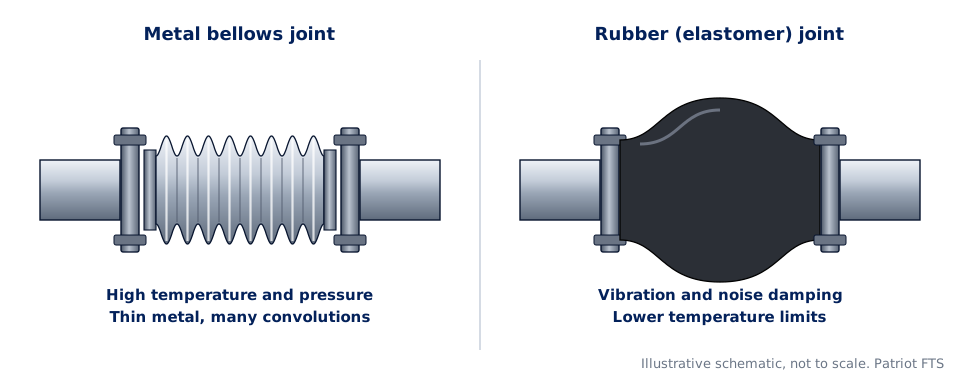
| Temperature | Cryogenic to high temperature, limited by the alloy | Limited by the elastomer; much lower than metal |
| Pressure | Low to high, by design | Generally lower |
| Movement | Axial, lateral, angular by type; little torsion | Axial, lateral, angular and some torsion in one unit |
| Vibration and noise | Isolates vibration; transmits more noise | Strong damping of vibration and noise |
| Chemical resistance | Set by alloy; sensitive to chlorides in stainless | Set by elastomer and liner |
| Abrasion | Thin wall; liner needed for erosive flow | Thick elastomer often handles slurry well |
| Fire exposure | Metal does not burn | Elastomer can fail in fire |
| Ageing | Fatigue from cycling; no elastomer ageing | Elastomer hardens and cracks with age, heat, ozone and UV |
| Pressure thrust | Needs anchors or restraints | Also needs anchors or control rods |
Ratings for any specific joint come from its data sheet; the table describes typical differences.
When to choose a metal expansion joint
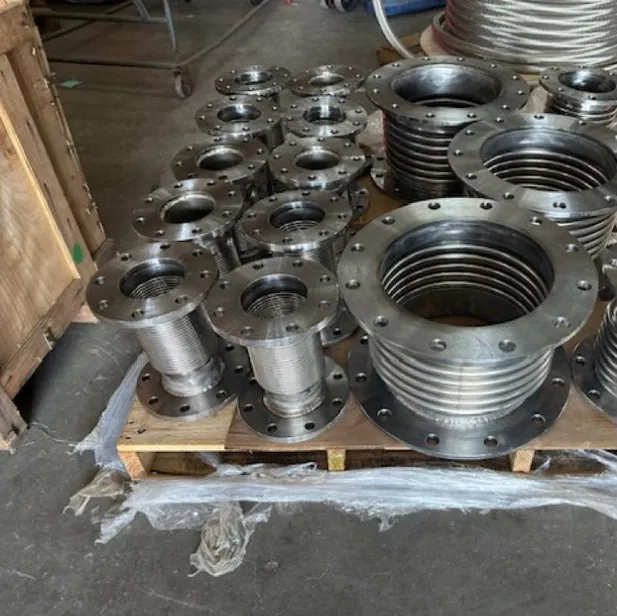
- Steam, condensate, hot oil, hot gas and other high-temperature services.
- Higher pressure lines, or services that require all-metal construction.
- Hydrocarbon and chemical services where elastomers are not compatible or fire exposure is a concern.
- Cryogenic service.
- Large thermal growth that needs universal, hinged, gimbal or pressure balanced designs.
When a rubber joint may suit
- Water, wastewater and HVAC pump connections where noise and vibration damping matter most.
- Abrasive slurries at moderate temperature.
- Systems with small combined movements, including some torsion.
Other options
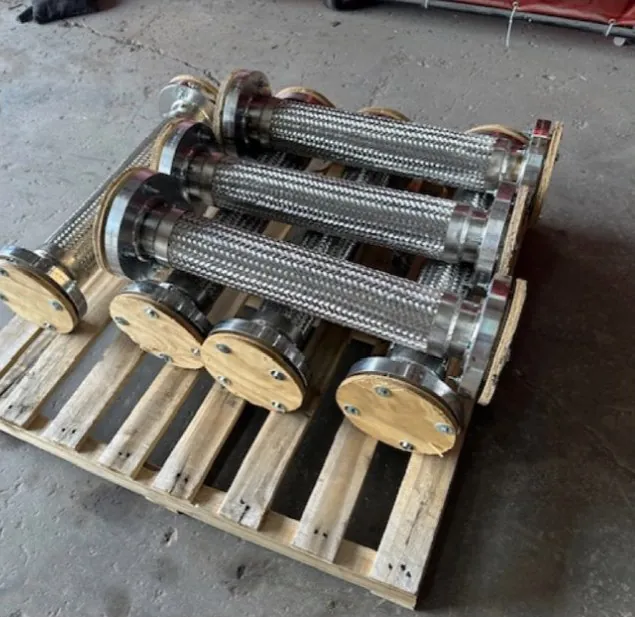
For pump vibration, a braided flexible metal pump connector gives all-metal construction in a short length. For thermal growth where space allows, a flexible metal hose loop develops no pressure thrust. Patriot FTS supplies metal expansion joints, pump connectors and loops; send your conditions and we will suggest the right fit.
Ready to quote? Use the expansion joint quote builder to enter movements, pressure and temperature and email the specification, or call (337) 573-4406. Bellows design, movement capacity, ratings and dimensions are confirmed by Patriot FTS at quote.
Frequently asked questions
Is a metal or rubber expansion joint better?
Neither is better in general. Metal suits high temperature, high pressure and fire-sensitive services; rubber suits vibration and noise damping at moderate temperature.
Can rubber expansion joints be used on steam?
Steam temperatures usually exceed what elastomers handle well, so metal joints are the normal choice for steam.
Do rubber expansion joints need anchors?
Yes. Rubber joints also develop pressure thrust and need anchors or control rods.
Which lasts longer?
It depends on service. Metal bellows wear by fatigue from cycling; rubber joints age from heat, ozone and UV even without cycling.