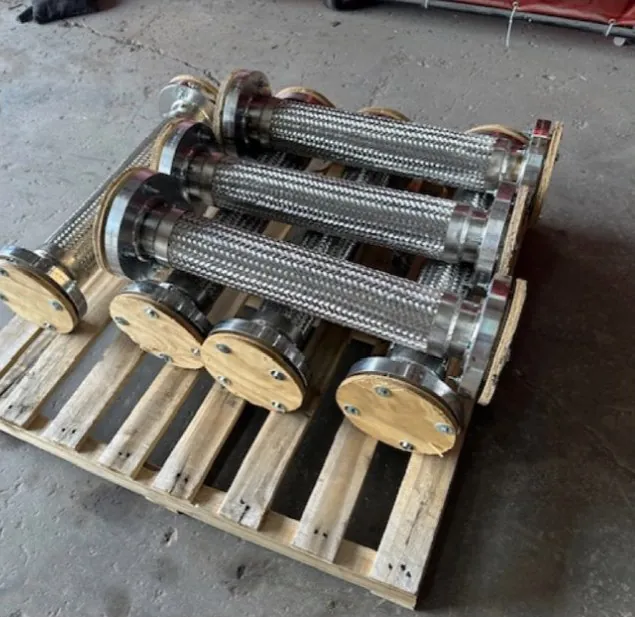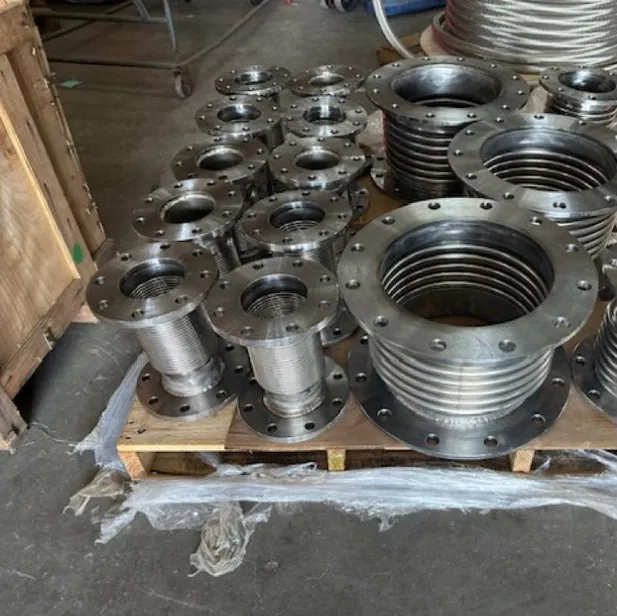
Receiving and storage
- Check the tag against the order: size, ends, rating, movements, materials and flow direction.
- Inspect for dents, scratches or arc strikes on the convolutions. A small dent in a thin bellows can shorten its life.
- Store in the shipping crate, indoors or covered, away from weld spatter, grinding and chlorides.
- Lift by the end fittings or lifting lugs, never by the bellows, rods or shipping bars.
Installation
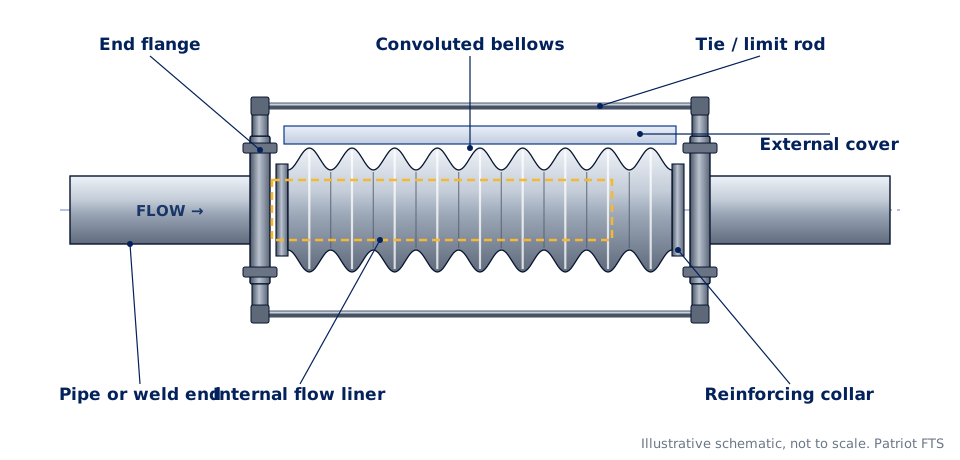
- Align the piping first. Do not use the joint to correct misalignment unless it was designed for that offset.
- Set the installed length. Install at the face to face length on the drawing, including any precompression or prestretch (cold set).
- Check orientation. Liners must point with the flow. Hinged and gimbal joints must be oriented as drawn.
- No torsion. Rotate flanges, not the bellows, to line up bolt holes. Bellows tolerate very little twist.
- Protect the bellows. Shield it from weld spatter, arc strikes and grinding. Never ground a welder through the bellows.
- Install anchors and guides to the piping design before the system is pressurized.
- Remove shipping bars only after the joint is installed and anchors and guides are in place. Follow the tag for whether they come off before or after the pressure test. Tie rods and limit rods are not shipping bars and stay in place.
- Insulation: keep insulation off the convolutions unless the joint has a cover designed for it.
Pressure testing
- Confirm all main anchors, guides and supports are complete before the hydrotest.
- Do not exceed the joint's rated test pressure. A system test above it can cause squirm or rupture.
- Watch the bellows during the test. Uneven convolution spacing or bowing means stop and depressurize.
- Drain fully after hydrotest, especially for stainless bellows that may see chloride-bearing water.
In-service inspection
| Look for | What it can mean |
|---|---|
| Uneven convolution spacing or a bowed bellows | Squirm from over-pressure, missing guides or too much movement |
| Leaks, weeping or stains | Fatigue crack or corrosion through the thin wall |
| Pitting, discoloration, deposits | Corrosion, including chloride stress corrosion of stainless steel |
| Dents, gouges, arc strikes | Mechanical damage that concentrates stress |
| Joint stretched or compressed beyond normal | Anchor or guide failure, or movement beyond design |
| Twist visible across the convolutions | Torsion from piping movement or installation |
| Loose or bent rods, worn hinge pins | Hardware overload |
| Damaged guides, anchors or supports | Loss of control of the piping movement |
Record installed length and rod settings at start-up so later inspections can compare. Inspect after any upset such as water hammer, over-temperature or a seismic event.
When to replace
Replace a joint that leaks, shows squirm, has corrosion through the convolutions, or has been damaged or overextended. Bellows cannot be patched reliably. Send the tag information and photos and Patriot FTS can quote a replacement to the original data or an upgraded material.
Ready to quote? Use the expansion joint quote builder to enter movements, pressure and temperature and email the specification, or call (337) 573-4406. Bellows design, movement capacity, ratings and dimensions are confirmed by Patriot FTS at quote.
Frequently asked questions
When should shipping bars be removed?
Only after the joint is installed and anchors and guides are in place. Follow the joint tag for timing relative to the pressure test. Tie and limit rods are permanent.
Can an expansion joint correct pipe misalignment?
Only if it was designed for that offset. Align the piping first; using the joint to force alignment uses up movement and shortens life.
Why must anchors be installed before the hydrotest?
Pressure thrust on an unrestrained joint will extend it without anchors, which can destroy the bellows.
What does squirm look like?
Uneven convolution spacing or the center of the bellows bowing sideways under pressure.
Can a damaged bellows be repaired?
Generally no. Leaking, squirmed or corroded bellows should be replaced.