How a universal expansion joint works
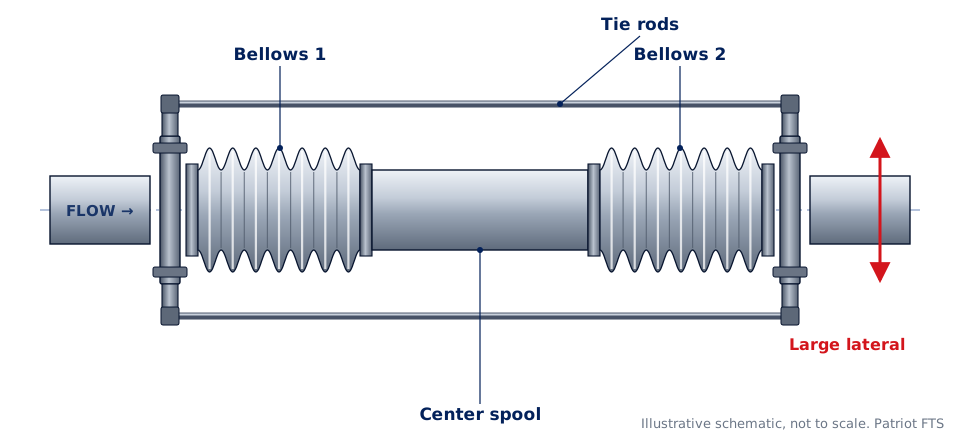
A universal joint has two bellows of equal length separated by a length of pipe called the center spool. When one end moves sideways, each bellows rotates through a small angle and the spool swings between them. The lateral capacity depends on the angle each bellows can take and on the spool length: a longer spool gives more offset for the same bellows.
An untied universal joint can also take axial movement, but like a single joint it then needs main anchors to resist pressure thrust and careful guiding. In most piping the universal joint is supplied tied.
Tied universal expansion joints
Tie rods run from one end fitting to the other across both bellows. They carry the pressure thrust, so the adjacent anchors only see the bellows spring forces and friction, not the full thrust. The rods let the joint offset laterally but prevent it from absorbing axial growth in the pipe outside the joint. Thermal growth of the center spool itself is taken up by the bellows.
Because the thrust is contained, a tied universal joint is often the practical choice where main anchors would be large, expensive or hard to place, such as high in a pipe rack or near equipment.
Where universal joints are used
- At a 90° change of direction, absorbing the growth of the leg that runs into the joint as lateral offset.
- Z-shaped and L-shaped pipe runs in plants and pipe racks.
- Connections between vessels, exchangers or turbines where thermal growth is sideways.
- Low-pressure exhaust and duct systems with large movements.
Design notes
- Universal joints are longer and heavier than single joints. The spool may need support so that its weight does not sag the bellows.
- Control rods can be added to share movement equally between the two bellows.
- Pipe on both sides should be guided so the movement is delivered as designed. Hinged or gimbal pairs are alternatives when only angular movement is needed.
- Squirm limits are lower for long bellows at high pressure, which affects bellows selection.
Specifying a universal expansion joint
Send pipe size, end connections, design and test pressure, temperature, media, the lateral offset in each direction, any axial and angular movement, cycles and the face to face length available. A sketch of the piping showing the joint location, anchors and the direction of growth helps us confirm the configuration.