How a gimbal expansion joint works
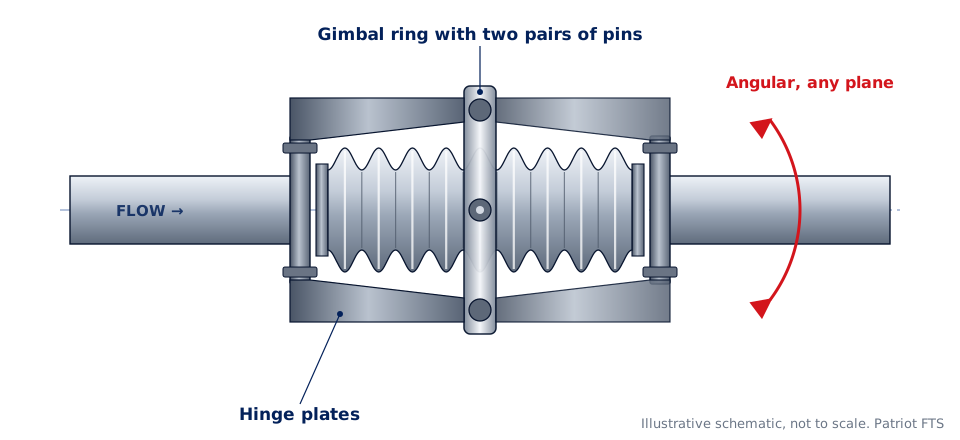
A rectangular or round gimbal ring surrounds the bellows. One pair of pins connects the ring to the plates on one end of the joint, and a second pair, at 90° to the first, connects it to the other end. Rotation about either pin axis, or any combination, lets the joint bend in any plane. The ring and pins carry the full pressure thrust, so the adjacent piping does not need main anchors to resist it, and the hardware also prevents torsion of the bellows.
Gimbal systems
Like hinged joints, gimbal joints only rotate, so they are used in sets:
- Two gimbal joints absorb lateral movement in any direction in a pipe leg between them.
- Two gimbal joints plus a hinged joint absorb growth from legs running in different planes, a common arrangement for three-dimensional piping.
Where gimbal joints are used
- Three-dimensional piping where growth comes from more than one direction.
- Large hot lines at turbines, exchangers and vessels where nozzle loads must stay low.
- Offsets and risers that move in two horizontal directions.
Gimbal vs hinged joints
| Feature | Hinged | Gimbal |
|---|---|---|
| Rotation | One plane | Any plane |
| Thrust | Carried by hinges | Carried by gimbal ring |
| Hardware | Plates and one pin pair | Ring, plates and two pin pairs |
| Typical layout | Planar Z or L runs | Three-dimensional runs |
| Size and cost | Lower | Higher |
If all the movement lies in one plane, a hinged joint is simpler and lower cost.
Specifying a gimbal expansion joint
Send pipe size, end connections, design and test pressure, temperature, media, angular rotation and its directions, cycles, available length and a piping sketch showing anchors and the direction of growth in each leg.