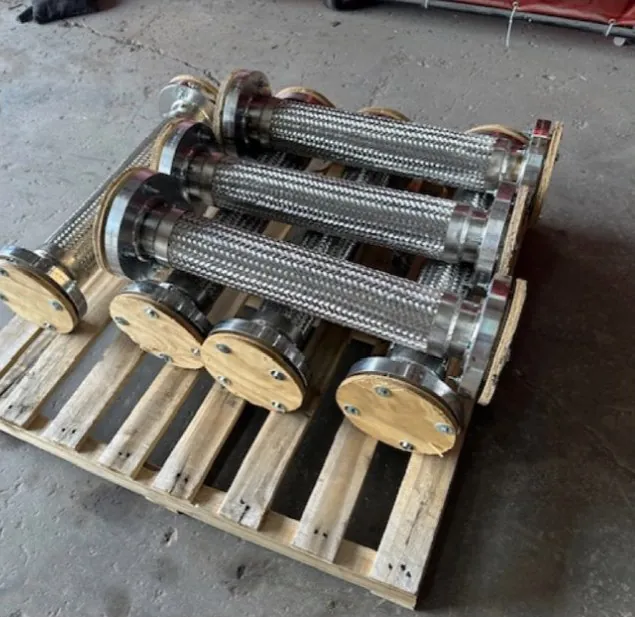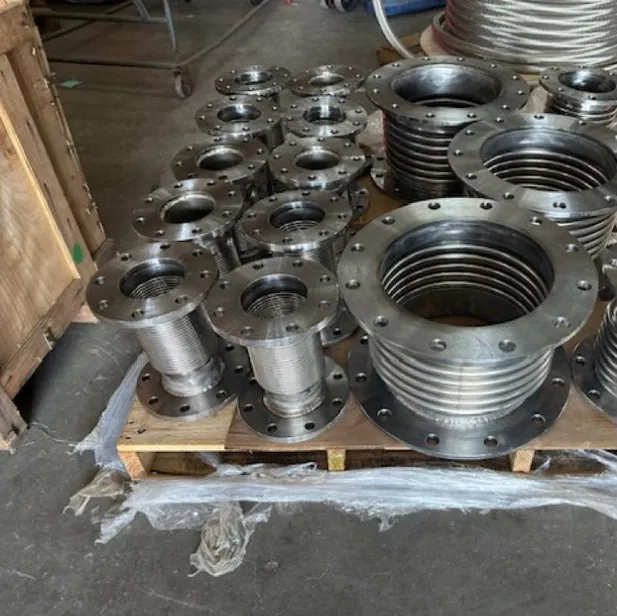
How a pressure balanced expansion joint works
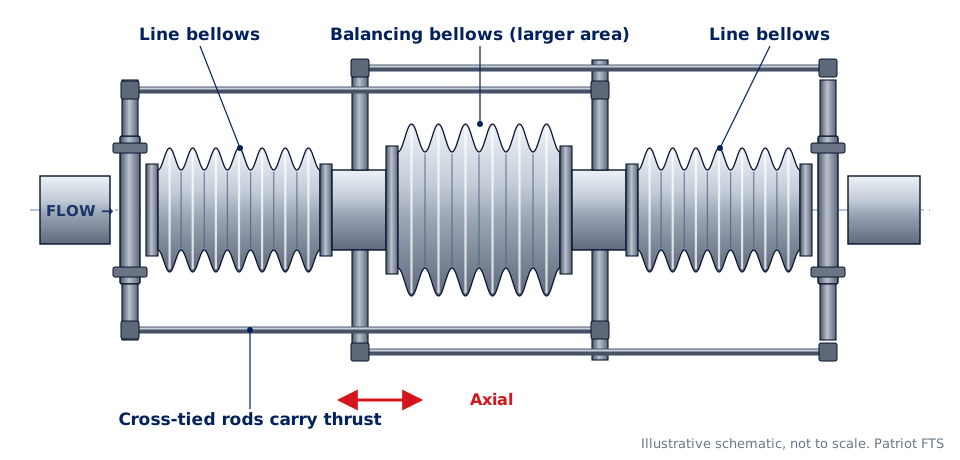
In an ordinary axial joint, pressure on the bellows effective area pushes the anchors apart. A pressure balanced joint adds a balancing bellows with a larger effective area and links the parts with tie rods so that, when the line bellows compresses, the balancing bellows extends. The pressure force on the balancing bellows is equal and opposite to the force on the line bellows, so the thrust is contained inside the joint. The anchors only see the bellows spring forces and guide friction.
In-line and elbow designs
- In-line pressure balanced: two line bellows and a central balancing bellows in a straight run. Used where axial movement must be absorbed and main anchors cannot be built, such as between two large vessels or high in a structure.
- Elbow pressure balanced: a line bellows before an elbow and a balancing bellows behind it, tied together. Installed at a change of direction, often at turbine or compressor nozzles, so axial growth of the line is absorbed without thrust on the equipment.
Where pressure balanced joints are used
- Turbine, compressor and pump connections with tight nozzle load limits.
- Short straight runs between vessels where a main anchor would be massive.
- Elevated piping where anchor structures are costly.
- Retrofits where existing anchors cannot take added thrust.
Design notes
- Pressure balanced joints are larger, heavier and more costly than single joints. They pay off when they eliminate expensive main anchors or protect equipment.
- The joint is engineered for its specific pressure, temperature and movement; the balancing bellows area must match.
- Pipe guides are still needed to keep movement aligned.
- Compare against a flexible loop, which also develops no pressure thrust if space allows.
Specifying a pressure balanced expansion joint
Send pipe size, end connections, design and test pressure, temperature, media, axial and lateral movements, cycles, allowable nozzle or anchor loads, available length and a sketch showing the piping, any elbow and the equipment the joint protects.
Ready to quote? Use the expansion joint quote builder to enter movements, pressure and temperature and email the specification, or call (337) 573-4406. Bellows design, movement capacity, ratings and dimensions are confirmed by Patriot FTS at quote.
Frequently asked questions
What is a pressure balanced expansion joint?
A joint with an extra balancing bellows and tie rods that cancel pressure forces internally, so axial movement is absorbed without pressure thrust on the anchors.
When should I use a pressure balanced joint?
When axial movement must be absorbed and main anchors are impractical, or when equipment nozzles cannot take pressure thrust.
What is the difference between in-line and elbow pressure balanced joints?
In-line joints sit in a straight run with a central balancing bellows. Elbow joints sit at a change of direction with the balancing bellows behind the elbow.
Do pressure balanced joints still need guides?
Yes. Guides keep the pipe aligned so the movement goes into the bellows as designed.