How a hinged expansion joint works
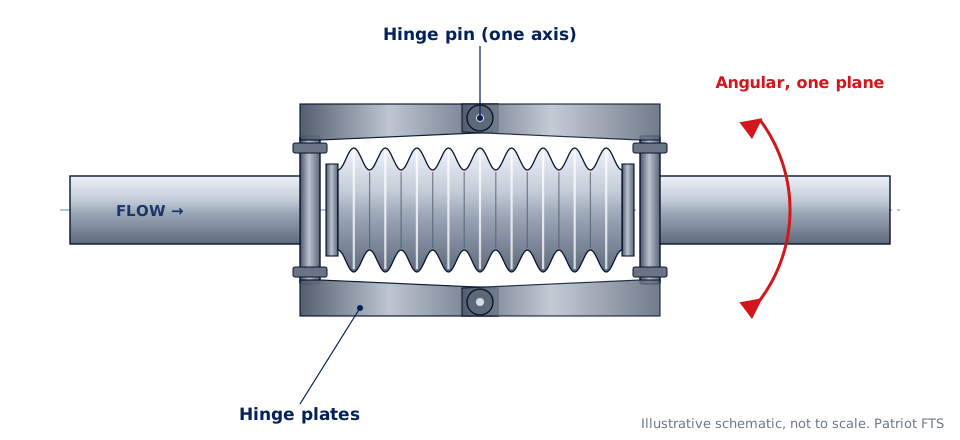
Hinge plates are attached to each end of the joint and connected by pins on a common axis through the middle of the bellows. The joint can bend about that axis like a door hinge, but it cannot extend, compress or bend in any other plane. The hinge hardware is designed to carry the full pressure thrust, so the adjacent piping does not need main anchors to resist it. The hinges can also carry other loads, such as the weight of pipe or wind.
Two-hinge and three-hinge systems
A single hinged joint only rotates, so on its own it does not absorb pipe growth. Hinged joints work in sets:
- Two-hinge system: two hinged joints in a Z-shaped or L-shaped run, both rotating in the same plane, absorb the growth of the leg between them as lateral movement.
- Three-hinge system: three hinged joints absorb growth from two legs in the same plane. The third joint takes up the small change in geometry as the system flexes.
Because all the movement is rotation, hinged systems can take very large thermal growth with relatively low forces on the anchors, which is why they are used on large-diameter hot lines.
Where hinged joints are used
- Large-bore steam, hot gas and process lines laid out in one plane.
- Pipe racks and offsets where main anchors for an axial joint would be impractical.
- Duct systems with large planar movements.
Design notes
- All movement must lie in the plane of the hinges. For movement in more than one plane, use gimbal joints.
- Slotted hinges can add a small amount of axial movement where needed.
- The piping between hinged joints must be supported and guided so the system moves in the intended plane.
- Hinge orientation is set on the drawing and must be followed at installation.
Specifying a hinged expansion joint
Send pipe size, end connections, design and test pressure, temperature, media, the angular rotation for each joint, cycles, available length and a sketch of the piping showing hinge orientation, anchors and the direction of growth. If you are not sure whether hinged or gimbal joints fit, send the layout and we will review it.