
Request a Quote (337) 573-4406 sales@patriotfts.com
Metal bellows expansion joints, including externally pressurized designs

Home / Products / Metal Expansion Joints / Externally Pressurized Expansion Joint

Externally Pressurized Expansion Joint Long axial travel, bellows protected inside a casing.

In an externally pressurized expansion joint, the line media flows around the outside of the bellows inside a pressure casing. Pressure on the outside keeps the bellows stable, so the joint can take large axial movement on steam and hot water lines.

OutsidePressure acts on the bellows
LargeAxial travel
CasingProtects the bellows
MainAnchors still required

How an externally pressurized joint works
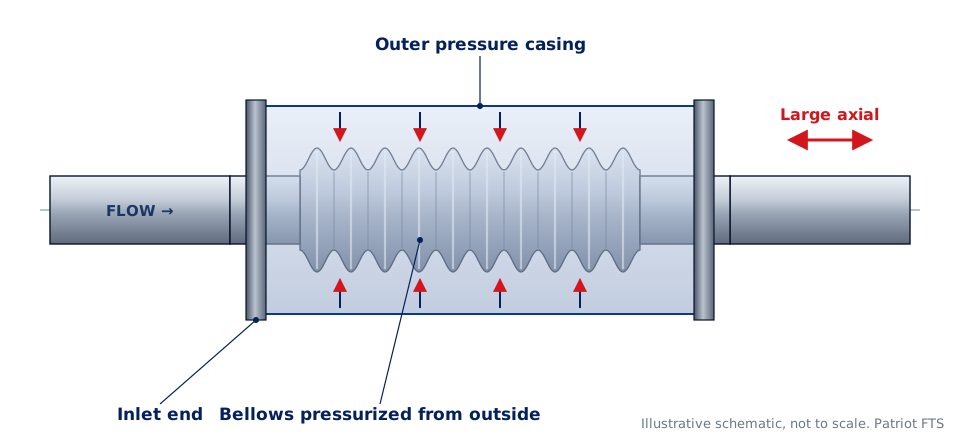
Externally pressurized expansion joint showing the outer pressure casing, bellows inside and pressure arrows acting on the outside of the bellows
Externally pressurized joint. The media fills the casing and presses on the outside of the bellows.

The bellows sits inside a cylindrical outer casing. Flow enters the casing at one end and passes around the outside of the bellows, so the convolutions are loaded in compression from outside rather than pushed apart from inside. The casing also contains the pressure, guides the moving parts and shields the bellows from mechanical damage, insulation and the weather.

Why external pressure helps

A long bellows under internal pressure can squirm: the center bows out like a column under load. Under external pressure that instability is largely removed, so a much longer bellows with more convolutions can be used. The result is a joint that can take far more axial travel than an internally pressurized single joint of the same size. Drainage is also easier, because condensate does not collect inside the convolutions.

Where externally pressurized joints are used

  • Long steam and condensate runs with large thermal growth.
  • Hot water distribution and district energy piping.
  • Lines where an exposed bellows would be at risk of damage.

Anchors and guides

An externally pressurized joint is still an unrestrained axial joint, so main anchors must resist the pressure thrust based on the bellows effective area. The built-in casing provides some internal guiding; manufacturers commonly allow the first pipe guide farther from this type than the 4 pipe diameter rule for an ordinary single joint, but guide locations must follow the joint data sheet. See pressure thrust, anchors and guides.

Specifying an externally pressurized joint

Send pipe size, end connections, design and test pressure, temperature, media, total axial compression and extension, cycles, available length and drain or vent requirements.
Ready to quote? Use the expansion joint quote builder to enter movements, pressure and temperature and email the specification, or call (337) 573-4406. Bellows design, movement capacity, ratings and dimensions are confirmed by Patriot FTS at quote.

Frequently asked questions

What is an externally pressurized expansion joint?
A joint in which the line pressure acts on the outside of the bellows inside a pressure casing, allowing long axial travel.
Why use external pressure?
External pressure stabilizes the bellows against squirm, so a longer bellows with more movement can be used.
Does it need main anchors?
Yes. It is an unrestrained axial joint, so main anchors resist pressure thrust.
Where are externally pressurized joints common?
Steam, condensate and hot water lines with large thermal growth.

Need it fast?

Call our on-call team any time, day or night, or send your specs online.

(337) 573-4406 Request a Quotesales@patriotfts.com
Designed. Fabricated. Tested. Delivered.  |  Built for performance. Built to last.