
Home / Tech Reference / Expansion Joint Quote Builder
Expansion Joint Quote Builder Send a complete spec the first time.
Enter axial, lateral and angular movements with design conditions, check that the joint type suits them, estimate pressure thrust and email one clean specification. Free, no login.
Patriot FTS Expansion Joint Quote Builder
Specification summary
Joint schematic
Joint types and the movement they take
Specification sheet
Results are preliminary engineering estimates from catalog data and published industry formulas. Patriot FTS reviews every request and confirms hose construction, live length, ratings and movement capacity on the quote.
How to specify a metal expansion joint
A bellows expansion joint is designed around its movements and its pressure. Sending complete movement data the first time is the fastest way to a correct quote. The builder collects everything we need, checks that the joint type suits the movements, estimates pressure thrust for anchor planning and puts it all in one email.
- Movements. Axial compression and extension in inches, lateral offset in inches and angular rotation in degrees, from the installed position. Include the number of cycles for thermal or mechanical cycling.
- Type. Single unrestrained joints take axial movement but push on the main anchors. Tied, hinged and gimbal joints restrain pressure thrust and take lateral or angular movement. Universal joints take large lateral offset with two bellows.
- Pressure thrust. An unrestrained bellows acts like a piston: thrust equals pressure times the bellows effective area, based on its mean diameter, not the pipe size. Anchor design customarily considers the test pressure, often 1.5 times design pressure.
- Guides. Axial joints need pipe guides. A common rule places the first guide within 4 pipe diameters of the joint and the second within 14 diameters of the first. Your piping engineer sets final anchor and guide locations.
Thrust (lbf) = P (psig) × π De² ÷ 4
Default De estimate = pipe OD + 1 in. (replace with the bellows data sheet value)
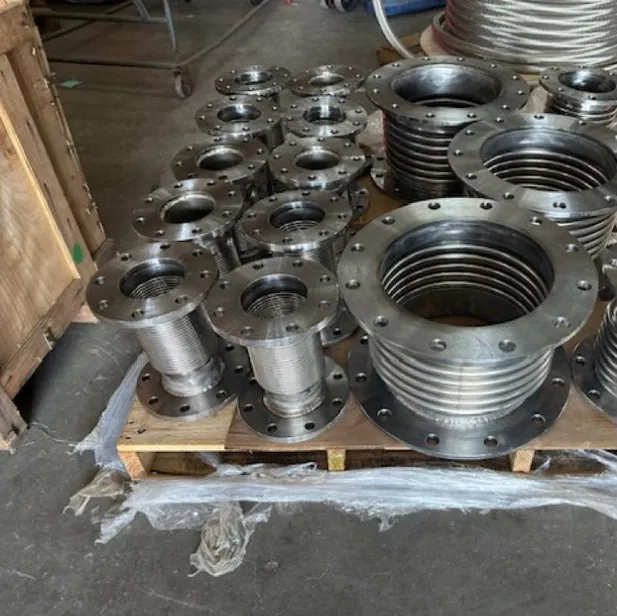
See the metal expansion joints page for joint types and options, or compare a joint with a flexible U-loop, which develops no pressure thrust. Bellows design, movement capacity, ratings and dimensions are confirmed by Patriot FTS at quote.
Frequently asked questions
What information do I need to quote an expansion joint?
Which expansion joint type should I use?
How do I calculate expansion joint pressure thrust?
Do I need a liner?
Can I send the specification without knowing the joint type?
Related tools and guides
- Metal Hose Selector
- Live Length and Bend Radius Calculator
- Expansion Loop Sizer
- Assembly Rating Checker
- Hose Quote List Builder
- Spec Sheet Builder
- Installation Checker
- Inspection and Retest Planner
- Flow Velocity and Pressure Drop Calculator
- Media Compatibility Checker
- Pump Connector Sizer
- Flex Service Screening
- Fitting and Connection Finder
- Overall Length Calculator
- Saturated Steam Calculator
- Unit Converter
- Braid Burst Calculator
- Water Hammer Calculator
- Metal expansion joints
- Expansion loop sizing guide
Need it fast?
Call our on-call team any time, day or night, or send your specs online.
(337) 573-4406 Request a Quotesales@patriotfts.com