
Home / Tech Reference / Braid Burst Calculator
Braid Burst Pressure Calculator See what the braid is doing.
Estimate theoretical burst and working pressure from carriers, wires per carrier, wire size, braid angle and tensile strength, with braid coverage. Free, no login.
Patriot FTS Braid Burst Calculator
Theoretical result
Burst pressure against braid angle
Same wires and diameter. A lower braid angle puts more of each wire in line with the pressure thrust.
Braid coverage
Results are preliminary engineering estimates from catalog data and published industry formulas. Patriot FTS reviews every request and confirms hose construction, live length, ratings and movement capacity on the quote.
How the braid calculation works
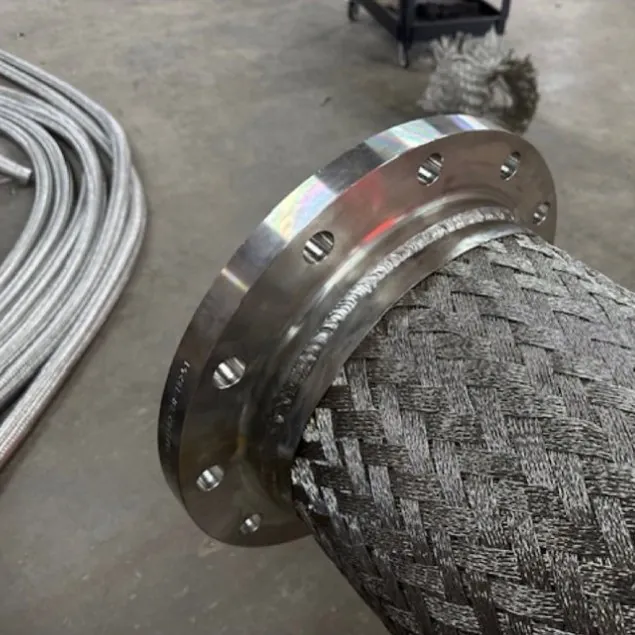
In a braided corrugated hose the corrugations carry hoop stress, and the braid carries the end thrust that pressure puts on the fittings. Every wire runs at the braid angle to the hose axis, so only the axial component of its strength resists thrust. Setting the total axial wire strength equal to the pressure thrust on the braid mean diameter gives a theoretical burst pressure.
Pburst = 4 × N × n × σ × Aw × cos α ÷ (π × Dm²) × layer factor
Aw = π d² ÷ 4 Coverage C = 2F − F², F = N × n × d ÷ (2 π Dm cos α)
- N carriers, n wires per carrier, d wire diameter, σ wire tensile strength, α braid angle from the hose axis, Dm braid mean diameter.
- Double braid. The outer layer does not share load evenly with the inner one. The tool applies a factor of 1.6 for two layers, the same figure shown on our single vs double braid page.
- Working pressure is the burst pressure divided by the ratio you set. A 4:1 burst to working ratio is the common basis for metal hose ratings.
This is a theoretical figure. Weld quality at the collar, braid tension, wire condition, corrugation strength and temperature all affect real burst pressure, which is why published catalog ratings come from testing. Catalog ratings govern; this tool is for understanding how braid choices move the number. Hose construction, ratings and dimensions are confirmed by Patriot FTS at quote.
Frequently asked questions
How is braided hose burst pressure calculated?
Why does braid angle matter?
Does a second braid double the pressure rating?
What is braid coverage?
Can I use this result as my hose rating?
Related tools and guides
- Metal Hose Selector
- Live Length and Bend Radius Calculator
- Expansion Loop Sizer
- Assembly Rating Checker
- Hose Quote List Builder
- Spec Sheet Builder
- Installation Checker
- Inspection and Retest Planner
- Flow Velocity and Pressure Drop Calculator
- Media Compatibility Checker
- Pump Connector Sizer
- Flex Service Screening
- Fitting and Connection Finder
- Overall Length Calculator
- Saturated Steam Calculator
- Unit Converter
- Water Hammer Calculator
- Expansion Joint Quote Builder
- Single vs double braid
- Metal hose pressure rating chart
Need it fast?
Call our on-call team any time, day or night, or send your specs online.
(337) 573-4406 Request a Quotesales@patriotfts.com