Quick selection guide
| Alloy | UNS | Key chemistry | Typical reason to choose |
|---|---|---|---|
| 316L stainless | S31603 | 2–3% Mo, 0.030% C max | Chlorides, salt air, many chemicals |
| 321 stainless | S32100 | Titanium stabilized | Elevated temperature, sensitization range |
| 304 / 304L stainless | S30400 / S30403 | 18 Cr / 8 Ni, no Mo | General service; standard braid alloy |
| Monel 400 | N04400 | Ni-Cu, 28–34% Cu | Seawater, HF acid, caustic, chlorine |
| Hastelloy C276 | N10276 | Ni-Mo-Cr, 15–17% Mo | Strong acids, chlorides, chlorine, sour |
| Inconel 625 | N06625 | Ni-Cr-Mo-Nb | High temperature, seawater, sour gas |
| Bronze | – | Copper alloy | HVAC, water, copper tube systems |
Screening guide only. Final selection depends on media, concentration, temperature, pressure and cleaning chemicals. We review every application before quoting.
Stainless steels: 316L, 321 and 304L
The flexible metal hose industry relies on 321 and 316L for most of its needs, with 304L or 316L braid. Choose between them on two questions:
- Chlorides or aggressive chemicals? Molybdenum-bearing 316L resists pitting and crevice corrosion better.
- Sustained heat? Titanium-stabilized 321 resists intergranular corrosion after exposure to 800–1500°F and resists oxidation to 1500°F.
- Neither? 304 or 304L handles general service and is the most common braid alloy.
Nickel alloys: Monel 400, C276 and 625
When stainless will not survive, step up to a nickel alloy. These are offered in specific hose series, so we confirm size and rating on each quote.
Monel 400
Nickel-copper. Resists seawater, steam, caustic and de-aerated hydrofluoric and hydrochloric acids. Poor with oxidizing salts such as ferric chloride.
Hastelloy C276
Handles both oxidizing and non-oxidizing acids, with outstanding pitting and crevice resistance in chlorides and halides.
Inconel 625
High-temperature strength with oxidation resistance to 1050°C, plus strong pitting and chloride stress cracking resistance.
Chlorine service
The Chlorine Institute recommends Monel 400 and C-276 for metallic chlorine hoses. C-276 is generally considered the better option.
Bronze
Bronze hose and braid is used most often in HVAC chiller connections, vibration eliminators with copper tube ends, water and seismic applications. See bronze metal hose.
Published pitting and crevice data
| Alloy | Critical pitting temp. | Critical crevice temp. | Chloride SCC (boiling MgCl2) |
|---|---|---|---|
| 316L | 59°F | 32°F | Cracked in 2 h |
| 625 | 212°F | 104°F | No cracking in 1,008 h |
| C-276 | 302°F | 131°F | No cracking in 1,008 h |
Published data in acidified 6% ferric chloride (72 h) and stressed U-bends in boiling 45% magnesium chloride. Higher temperatures are better.
Hose, braid and fittings are separate choices
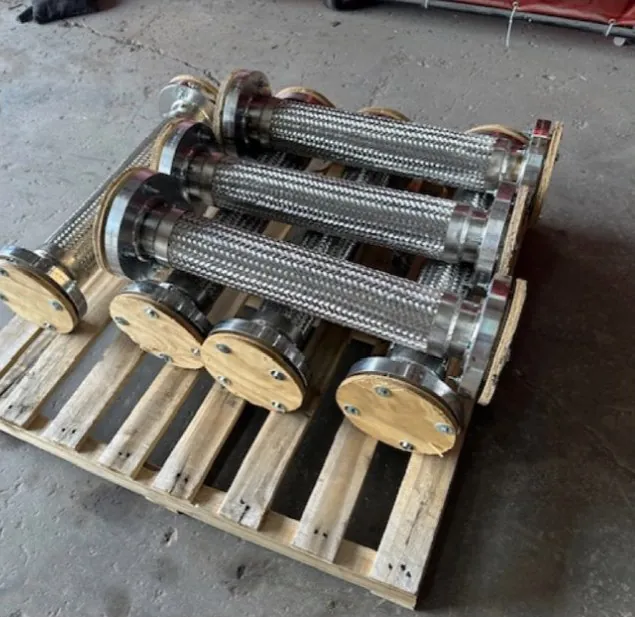
An assembly has three material decisions: the corrugated core that touches the media, the braid outside it, and the end fittings. They do not have to match. Our standard stainless pump connectors, for example, use a 321 hose with a 304L braid. If your spec requires every component in one alloy, say so on the request.
From the Technical Reference
Tools for this job
Free tools you can use now, then email the result to Patriot FTS for a quote.
Ratings and dimensions are confirmed by Patriot FTS at quote.