Where 304 stainless metal hose fits
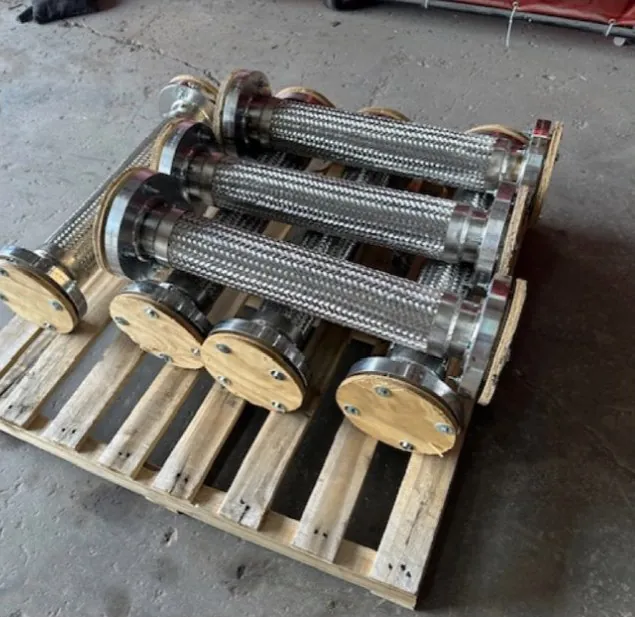
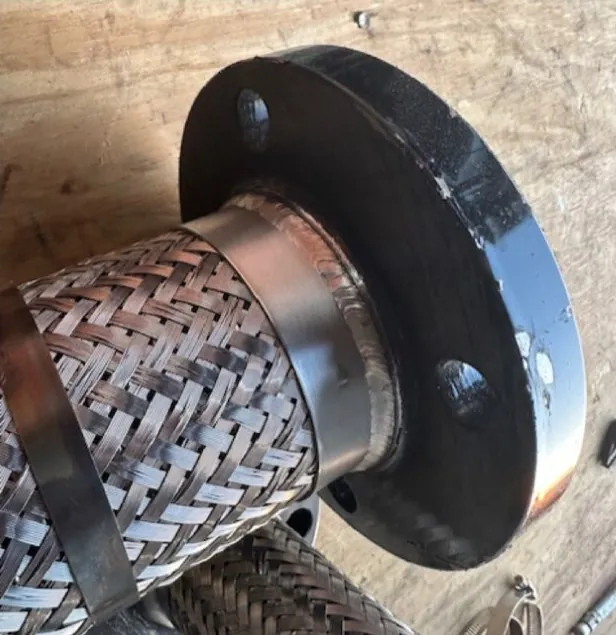
304 is the basic 18-8 austenitic stainless steel. In metal hose it shows up two ways: as a corrugated hose for general service with moderate corrosion and temperature, and, in its low-carbon 304L form, as the braid on many 321 and 316L hoses. Patriot FTS lists 304 stainless among its annular corrugated hose options and builds every assembly to order in Youngsville, Louisiana.
304L chemical composition
Composition limits for UNS S30403 per ASTM A240 (weight %).
| Element | C | Mn | P | S | Si | Cr | Ni | N |
|---|---|---|---|---|---|---|---|---|
| 304L | 0.030 max | 2.00 max | 0.045 max | 0.030 max | 0.75 max | 17.5–19.5 | 8.0–12.0 | 0.10 max |
Common equivalents: UNS S30403, EN 1.4307. Standard 304 (UNS S30400) allows up to 0.08% carbon.
304 vs 304L for welded assemblies
When 18-8 stainless spends time between about 800°F and 1500°F, chromium carbides can form at grain boundaries. The steel is then "sensitized" and can suffer intergranular corrosion in aggressive media. Weld heat-affected zones pass through this range.
- 304L limits carbon to 0.030%. Less carbon means more time before harmful carbides form, which is why 304L is preferred for parts used in the as-welded condition.
- It reduces the risk but does not remove it. Long service in the sensitization range can still sensitize 304L. For sustained hot service, titanium-stabilized 321 is the usual answer.
304L as a braid alloy
The braid carries most of the pressure load in a metal hose. Industry-standard construction pairs a 321 or 316L corrugated core with one or two layers of 304L or 316L braid. Our standard stainless pump connectors use 321 hose with a 304L braid. If you need the braid to match a 316L core for corrosion reasons, say so on the request.
Know the limits
304 and 304L contain no molybdenum, so they are more prone to chloride pitting than 316L. Salt air, brackish water and chloride-bearing chemicals usually call for 316L or a nickel alloy. See the alloy selection guide.
Pressure ratings
Pressure is set by series, size and braid layers. Representative published values, PSIG at 70°F:
| Series | 1/2" | 1" | 2" |
|---|---|---|---|
| P3 (1B / 2B) | 1,225 / 1,470 | 796 / 955 | 570 / 684 |
| 700 (1B / 2B) | 1,075 / 1,720 | 571 / 914 | 516 / 826 |
Published values with a minimum 4:1 safety factor. See the full chart and confirm alloy availability by series on the quote.
From the Technical Reference
Tools for this job
Free tools you can use now, then email the result to Patriot FTS for a quote.
Ratings and dimensions are confirmed by Patriot FTS at quote.