Why specify 316L stainless metal hose
316L is the workhorse alloy for braided metal hose when the media, the cleaning chemicals or the atmosphere around the line can attack ordinary stainless. Two things in its chemistry make the difference:
- Molybdenum (2.00–3.00%). Improves resistance to pitting and crevice corrosion in chloride service, such as salt air, brackish water and many process chemicals.
- Low carbon (0.030% maximum). The "L" grade limits carbon so the heat-affected zone next to each weld keeps its corrosion resistance. That matters on a hose assembly, where the hose, braid and fittings are all joined by welding.
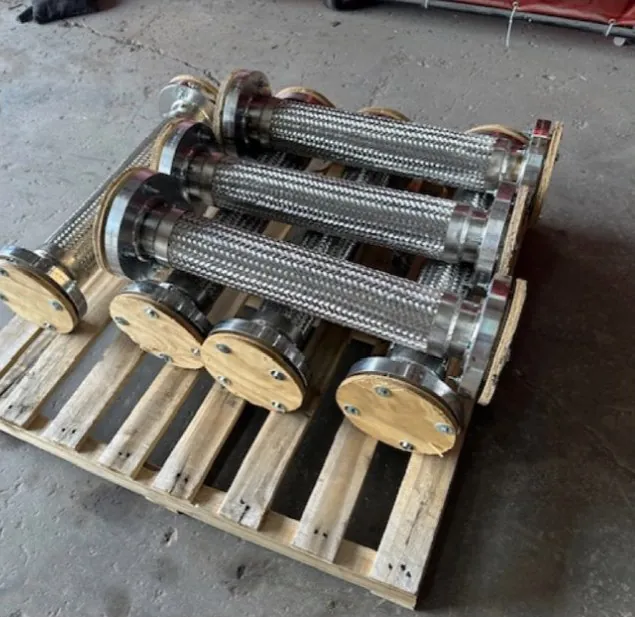
Patriot FTS builds 316L assemblies to order in Youngsville, Louisiana for refineries, chemical plants, offshore and marine work, power and industrial facilities. Every assembly is pressure tested before it ships.
316L chemical composition
Heat analysis limits for UNS S31603 per ASTM A240 (weight %).
| Element | C | Mn | P | S | Si | Cr | Ni | Mo | N |
|---|---|---|---|---|---|---|---|---|---|
| 316L | 0.030 max | 2.00 max | 0.045 max | 0.030 max | 0.75 max | 16.0–18.0 | 10.0–14.0 | 2.00–3.00 | 0.10 max |
Common equivalents: UNS S31603, EN 1.4404 (X2CrNiMo17-12-2), JIS SUS 316L.
316L vs 321 vs 304L for metal hose
| Alloy | Key chemistry | Typical reason to choose it |
|---|---|---|
| 316L | Molybdenum bearing, low carbon | Chlorides, salt air, many chemicals and corrosive cleaning fluids |
| 321 | Titanium stabilized | Higher-temperature service with moderate corrosion |
| 304L | No molybdenum, low carbon | General service with moderate corrosion and temperature |
If you are not sure which alloy fits, tell us the media, the temperature and any cleaning or flushing chemicals. Higher-alloy options are also available, including Monel 400, Hastelloy C276 and Inconel 625, for service that 316L cannot handle. See the alloy selection guide.
Construction options
| Hose type | 316 stainless sizes | Notes |
|---|---|---|
| Annular corrugated | 1/4" – 24" | Most common pressure hose. Single or double braid. |
| Interlocked (stripwound) | 1/2" – 28" | Low-pressure exhaust, dry bulk and protective conduit |
| Helical corrugated | 1/4" – 1" | Small-bore flexible lines |
Hose and braid alloy are separate choices
The corrugated core, the braid and the fittings can each be a different alloy. For example, our standard stainless pump connectors use a 321 stainless hose with a 304L braid. If your spec calls for an all-316 assembly, including the braid and fittings, say so on the request so every component is quoted in 316.
Pressure ratings
Working pressure depends on the hose series, the size and the number of braid layers. The table below shows published maximum working pressures at 70°F for representative sizes. See the full metal hose pressure rating chart for every size and series.
| Series | 1/2" | 1" | 2" | 4" |
|---|---|---|---|---|
| P3 (1B / 2B) | 1,225 / 1,470 | 796 / 955 | 570 / 684 | – |
| P4 (1B / 2B) | 1,240 / 1,980 | 630 / 1,000 | 532 / 850 | 300 / 444 |
| 700 (1B / 2B) | 1,075 / 1,720 | 571 / 914 | 516 / 826 | 232 / 371 |
| 800 (1B / 2B) | 2,194 / 3,510 | 1,069 / 1,710 | 810 / 1,296 | 333 / 533 |
PSIG at 70°F. 1B = one braid layer, 2B = two braid layers. Published values with a minimum 4:1 safety factor. Alloy availability varies by series; we confirm it on the quote.
End fittings
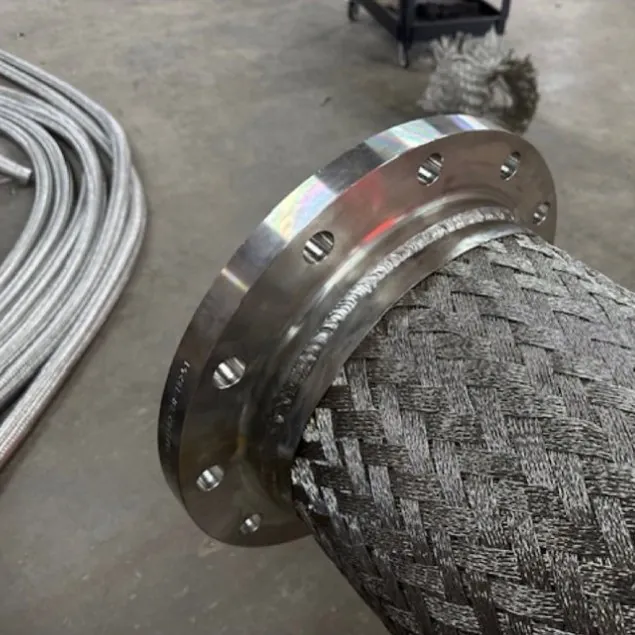
We weld or attach the end connections your system needs, in 316L or matched alloys:
- ANSI/ASME flanges, fixed x floating
- Male and female NPT
- Butt-weld and socket-weld ends
- JIC 37° flare
- Cam & groove
- Sanitary tri-clamp
- Grooved
- Unions and custom fittings
| ASME class | 150 | 300 | 600 | 900 | 1500 | 2500 |
|---|---|---|---|---|---|---|
| 316 flange (psi) | 275 | 720 | 1,440 | 2,160 | 3,600 | 6,000 |
| 316L flange (psi) | 230 | 600 | 1,200 | 1,800 | 3,000 | 5,080 |
Ambient-temperature ratings for screening. Ratings fall at elevated temperature.
How to specify a 316L hose assembly
- Size and length. Nominal ID and overall length, face to face or end to end.
- Media. What the hose carries, plus any cleaning or flushing chemicals.
- Pressure. Working, surge and test pressure, and vacuum if any.
- Temperature. Normal and maximum operating temperature.
- Motion. Static, vibration, offset, or constant flexing.
- End connections. Type, size, class and material for both ends.
- Paperwork. Test reports, MTRs or other documentation you need.
From the Technical Reference
Tools for this job
Free tools you can use now, then email the result to Patriot FTS for a quote.
Ratings and dimensions are confirmed by Patriot FTS at quote.