Why specify 321 stainless metal hose
321 is one of the two core alloys the flexible metal hose industry relies on, alongside 316L. Its defining feature is a titanium addition that ties up carbon, so the alloy keeps its resistance to intergranular corrosion after exposure to the chromium carbide precipitation range of 800–1500°F (427–816°C). Unstabilized grades such as 304 can be attacked along grain boundaries after time in that range.
- Hot service. Published data lists oxidation resistance to 1500°F (816°C) and higher creep and stress rupture properties than 304 and 304L.
- General corrosion comparable to 304. Good for moderate corrosion; for chlorides, 316L or a nickel alloy is usually the better choice.
- Proven in hose. Our standard stainless pump connectors use a 321 stainless hose with a 304L braid.
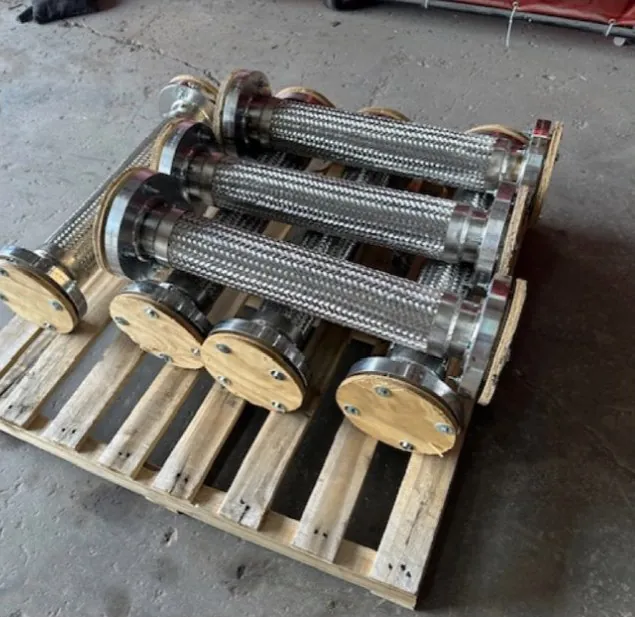
Typical published applications for the alloy include expansion joints, chemical processing, petroleum refining and thermal oxidizers. We build 321 assemblies to order in Youngsville for refinery, petrochemical, power and industrial users, and pressure test every assembly before it ships.
321 chemical composition
Composition limits for UNS S32100 per ASTM A240 (weight %).
| Element | C | Mn | P | S | Si | Cr | Ni | N | Ti |
|---|---|---|---|---|---|---|---|---|---|
| 321 | 0.08 max | 2.00 max | 0.045 max | 0.030 max | 0.75 max | 17.0–19.0 | 9.00–12.00 | 0.10 max | 5×(C+N) min, 0.70 max |
Common equivalents: UNS S32100, EN 1.4541 (X6CrNiTi18-10). 321H (UNS S32109) is the higher-carbon version.
321 vs 316L vs 304L
| Alloy | Key chemistry | Typical reason to choose it |
|---|---|---|
| 321 | Titanium stabilized | Elevated temperature, cycling through the sensitization range |
| 316L | Molybdenum bearing, low carbon | Chlorides, salt air and many chemicals |
| 304L | No molybdenum, low carbon | General service, common braid alloy |
Not sure which fits? See the metal hose alloy selection guide, or send us the media, temperature and pressure.
Construction options
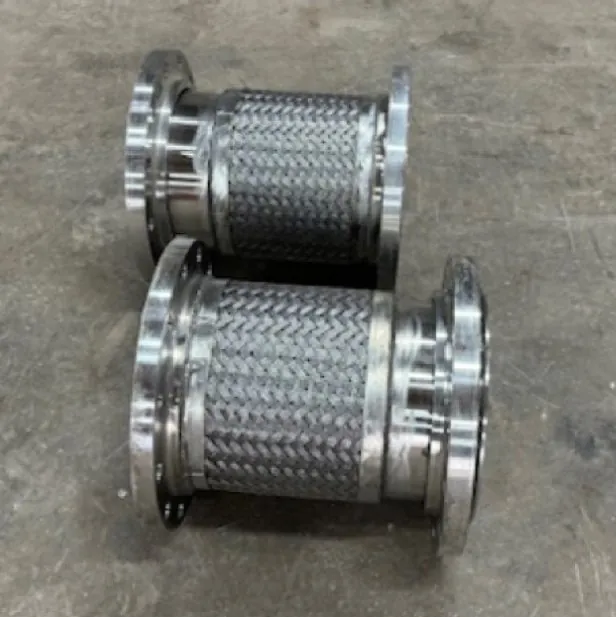
321 is supplied as annular corrugated hose with single or double braid. The braid and fittings are separate material choices. A 304L braid is common; specify 321 or 316L braid if your service calls for it. See single vs double braid for how braid affects pressure.
Pressure ratings
Working pressure depends on series, size and braid layers, not on 321 versus 316L alone. Representative published values, PSIG at 70°F:
| Series | 1/2" | 1" | 2" | 4" |
|---|---|---|---|---|
| P4 (1B / 2B) | 1,240 / 1,980 | 630 / 1,000 | 532 / 850 | 300 / 444 |
| 700 (1B / 2B) | 1,075 / 1,720 | 571 / 914 | 516 / 826 | 232 / 371 |
| 800 (1B / 2B) | 2,194 / 3,510 | 1,069 / 1,710 | 810 / 1,296 | 333 / 533 |
Published maximum working pressures with a minimum 4:1 safety factor. Ratings drop at elevated temperature, so hot 321 service must be derated. See the full pressure rating chart.
End fittings
- ANSI/ASME flanges, fixed x floating
- Male and female NPT
- Butt-weld and socket-weld ends
- JIC 37° flare
- Cam & groove
- Grooved
Tell us the size, length, media, pressure, temperature, motion and end connections. Our specification checklist covers everything we need to quote.
From the Technical Reference
Tools for this job
Free tools you can use now, then email the result to Patriot FTS for a quote.
Ratings and dimensions are confirmed by Patriot FTS at quote.