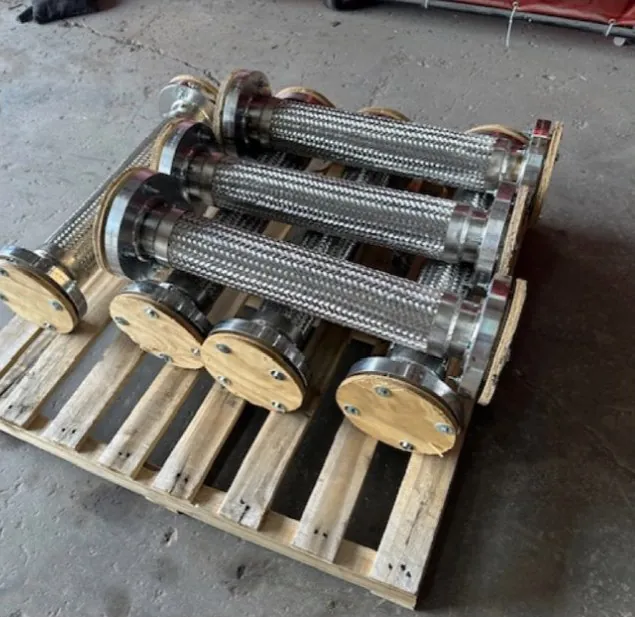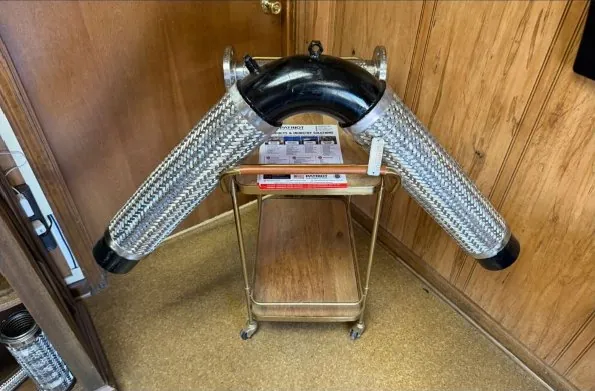
What a V-loop is
A V-loop uses two legs of braided metal hose set in a V, meeting at a return fitting. Like a U-loop, the legs flex in offset and angular motion, so the loop absorbs thermal growth and seismic movement in all directions without axial compression or torsion on the hose.
V-loop vs U-loop
| Factor | V-loop | U-loop |
|---|---|---|
| Offset (how far it sticks out) | Shorter | Longer |
| Footprint along the pipe | Longer | Shorter |
| Return fitting travel | Moves much more | Moves less |
| Typical fit | Risers, tight layouts, compact offsets | General thermal and seismic runs |
Geometry comparison based on published V-loop product data.
Where to use a V-loop
- Vertical risers in buildings
- Structural transitions and compact offsets
- Mechanical rooms where a U-loop's offset will not fit
- Compatible water and HVAC systems, in bronze or copper
Like other flexible loops, a V-loop develops no pressure thrust, so anchor loads and guiding requirements are low compared with in-line bellows joints.
Construction
We build 316 stainless V-loops for thermal movement, risers and structural transitions, and bronze / copper V-loops for compatible water and HVAC systems. Ends can be flanged, grooved, butt-weld or custom. Options include double braid for higher pressure. Final dimensions, ratings and movement capacity are set during application review.
Send pipe size, material, media, pressure, temperature, movement in each direction and available space. Our sizing guide shows how to estimate thermal movement.
From the Technical Reference
Tools for this job
Free tools you can use now, then email the result to Patriot FTS for a quote.
Ratings and dimensions are confirmed by Patriot FTS at quote.