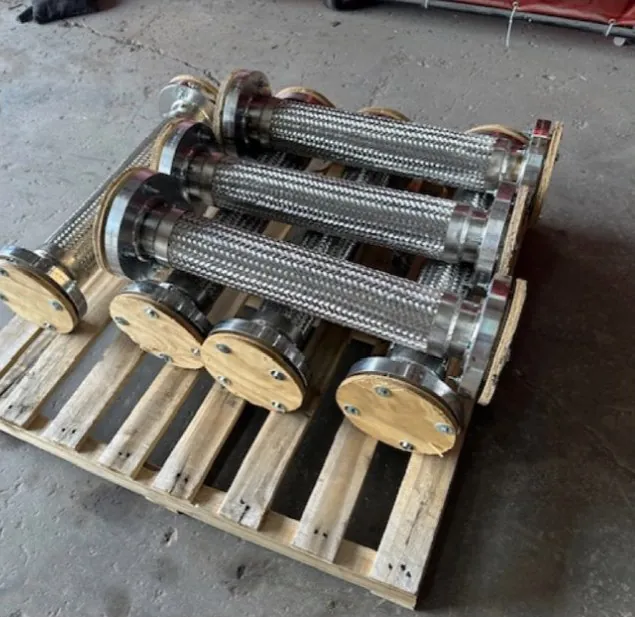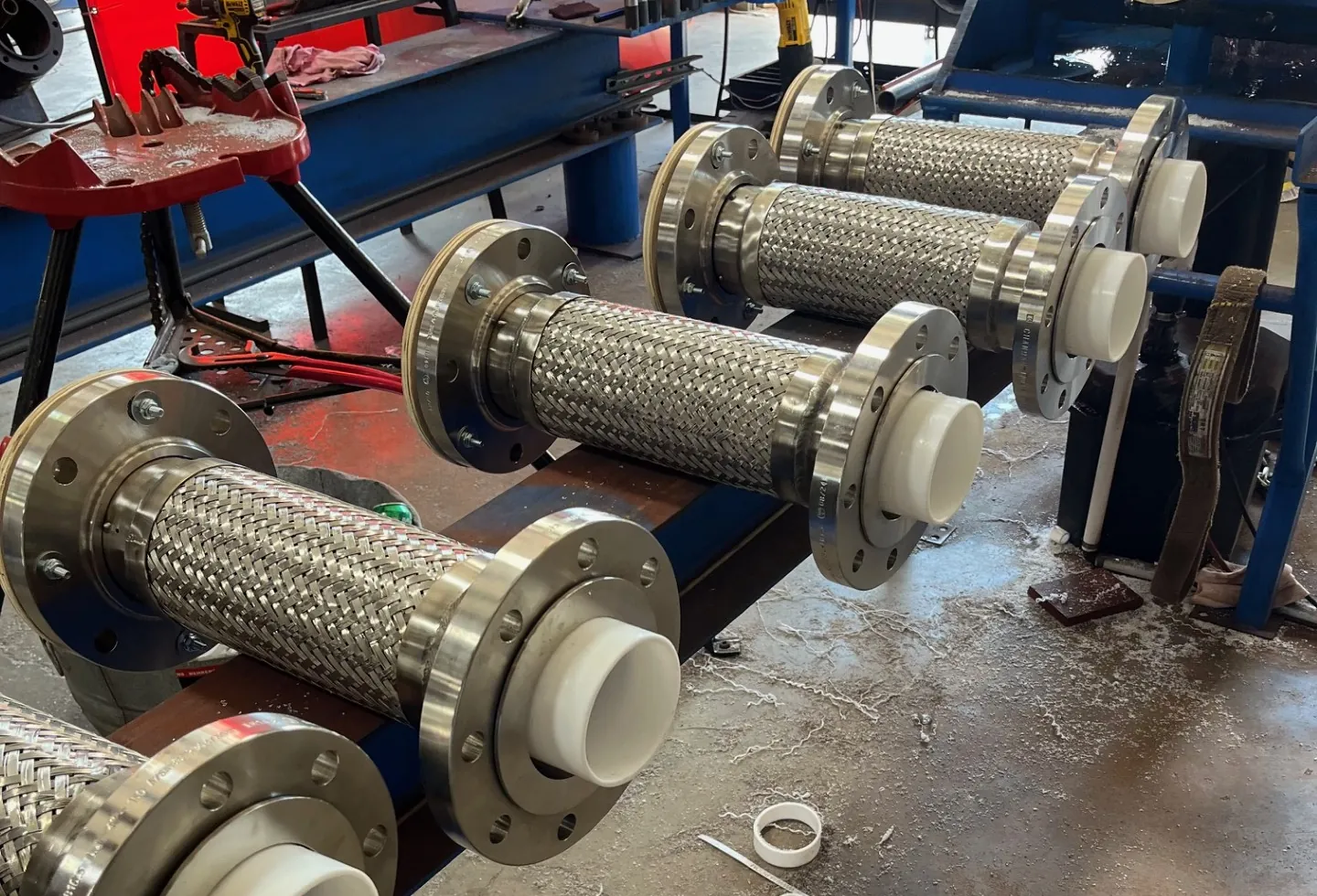
Smoothbore vs convoluted
PTFE resists nearly every industrial chemical and solvent, so the tube profile is usually the bigger decision. The trade-off in short: smoothbore PTFE has a higher working pressure, drains better and flows better, but it is stiffer. Convoluted PTFE is more flexible and lighter, with a much tighter bend radius.
| Factor | Smoothbore | Convoluted |
|---|---|---|
| Flow and drainage | Better: nothing for product to collect in | Convolutions add turbulence and hold residue |
| Flexibility | Stiffer, larger bend radius | Tight bend radius, resists kinking |
| Working pressure | Higher for a given size | Lower for a given size |
| Cleaning | Easier to clean and inspect | Open-pitch convolutions help with cleaning |
| Best fit | Fixed runs, high pressure, clean-in-place | Tight routing, frequent handling, suction |
Our PTFE range
| Construction | Sizes | Temp °F | Working pressure |
|---|---|---|---|
| Smoothbore, elastomer cover | 1/2"–2" | -20 to +300 | Up to 785 psi |
| Smoothbore, alloy braid | 1/2"–1" | -40 to +400 | Up to 1,425 psi |
| Convoluted, elastomer cover | 1/2"–2" | -20 to +300 | Up to 785 psi |
| Convoluted, alloy braid | 1/2"–4" | -20 to +400 | Up to 1,425 psi |
| Convoluted, Kynar® or PP braid | 1/2"–4" | -20 to +300 | Up to 500 psi |
Maximums for the range. Pressure falls as size and temperature rise, and the end fittings can set a lower assembly rating.
Static and conductive liners
PTFE is an electrical insulator. When a poorly conducting fluid moves fast through the hose, static can build until it arcs through the liner and leaves a pinhole leak. Fuels and steam are two services to watch. The usual fix is a conductive liner, with carbon in the inner wall that carries the charge to the metal fittings. Tell us if the media is flammable or a low-conductivity solvent so we can quote a conductive tube.
Chlorine transfer
Convoluted PTFE with a Kynar® or polypropylene braid is our chlorine transfer construction. Many chlorine users buy to the Chlorine Institute’s Pamphlet 6 hose guidelines. If your site requires that, say so on the request and we will quote a hose made to meet it.
What we need
- Media and concentration
- Temperature, normal and peak
- Pressure or vacuum
- Size and length
- End fittings and material
- Flammable or low-conductivity media
From the Technical Reference
Tools for this job
Free tools you can use now, then email the result to Patriot FTS for a quote.
Ratings and dimensions are confirmed by Patriot FTS at quote.