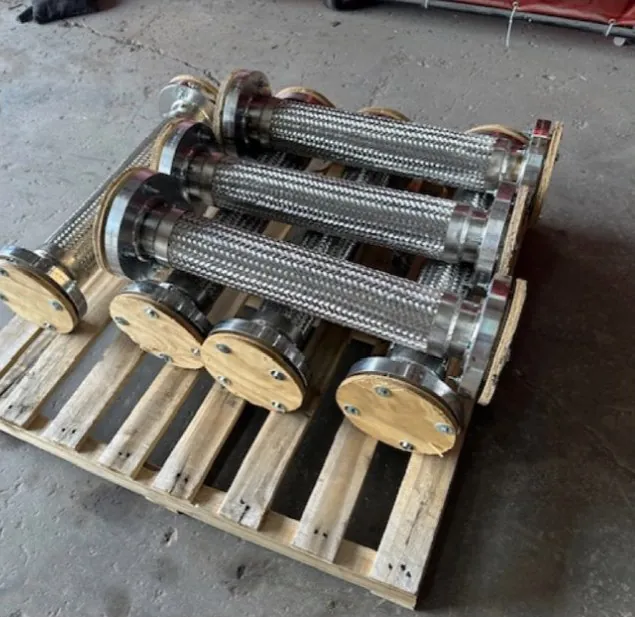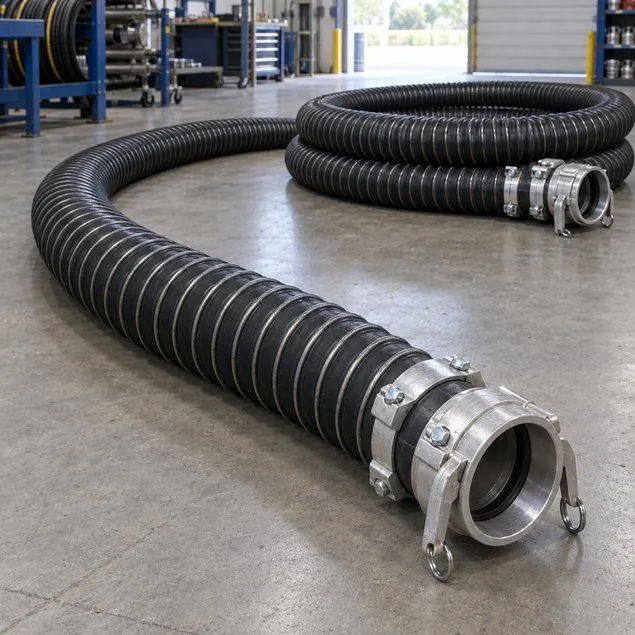
What 33 CFR 154.500 requires
US Coast Guard rule 33 CFR 154.500 covers every hose assembly used to transfer oil or hazardous material at a regulated facility. In short:
- Burst pressure at least four times the relief valve setting (or maximum pump pressure if there is no relief valve) plus the static head at the hose.
- Maximum allowable working pressure (MAWP) greater than that same sum.
- Nonmetallic hose must be suitable for oil or hazardous material service.
- Ends must be full threaded connections, flanges to ANSI B16.5 or B16.24, or quick-disconnect couplings to ASTM F1122.
- Marking as described below.
Checking the burst margin
Give us the relief valve setting (or maximum pump pressure) and the static head where the hose is installed. Add them together: the hose MAWP must be above that sum, and the burst pressure must be at least four times it. Example: a 100 psi relief setting plus 10 psi of head is 110 psi, so the hose needs an MAWP above 110 psi and a burst pressure of at least 440 psi.
Hose marking
| Item | Where |
|---|---|
| Product name, or "OIL SERVICE", or "HAZMAT SERVICE—SEE LIST" plus a symbol | On the hose |
| Maximum allowable working pressure | On the hose |
| Date of manufacture | On the hose, or in hose records if the hose is marked to identify it |
| Date of the latest test required by 33 CFR 156.170 | On the hose, or in hose records if the hose is marked to identify it |
| Burst pressure and test pressure | Not on the hose; recorded elsewhere at the facility |
Summary only. Read the full text of 33 CFR 154.500 and your facility operations manual for every requirement.
What we need
- Products transferred
- Relief setting or pump pressure
- Static head at the hose
- Size and length
- End type and flange class
- Marking required
From the Technical Reference
Tools for this job
Free tools you can use now, then email the result to Patriot FTS for a quote.
Ratings and dimensions are confirmed by Patriot FTS at quote.